
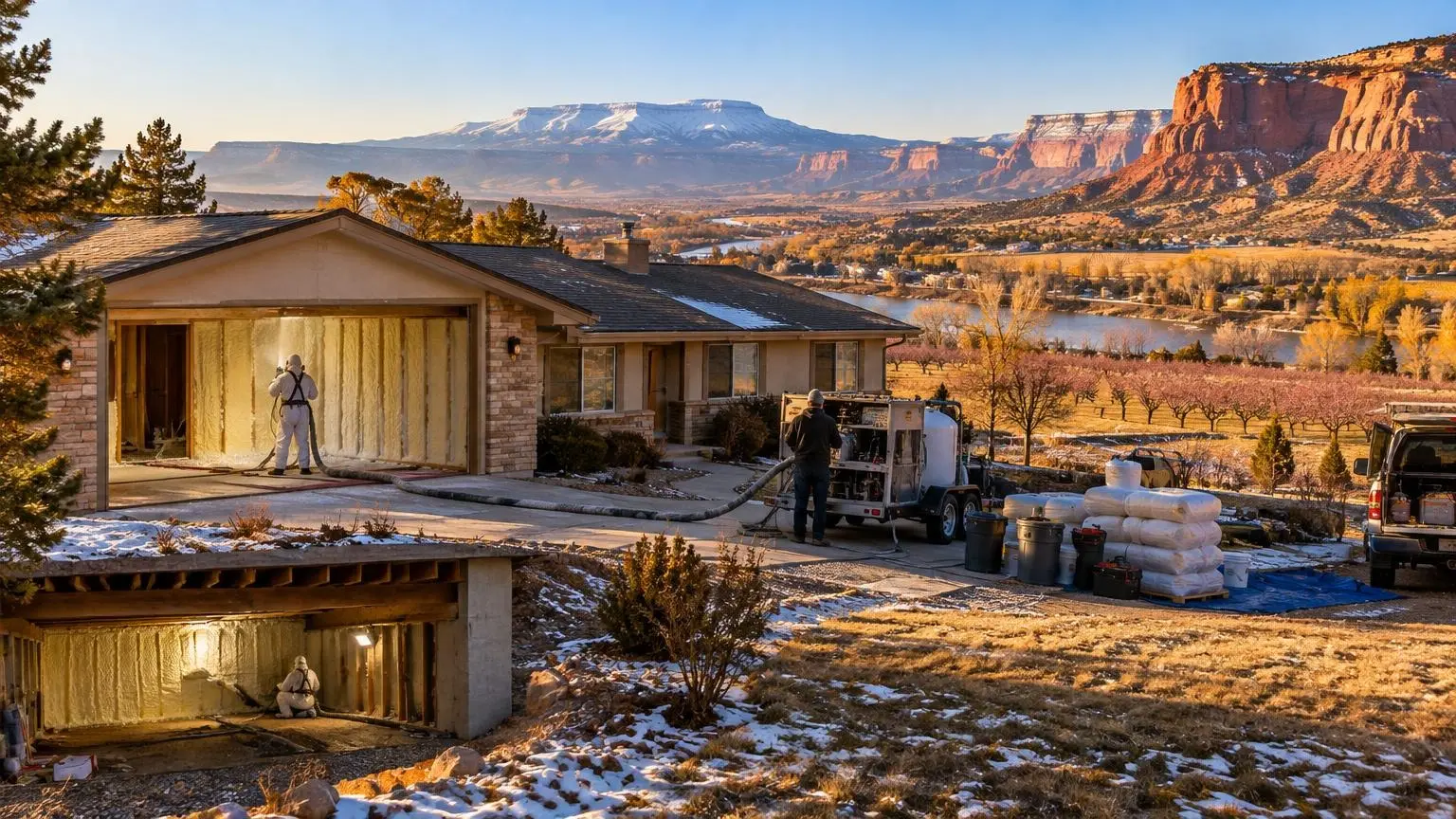
Homes, shops and ranch buildings across the Grand Valley
Spray Foam Insulation in Grand Junction, CO
Warmer winters and cooler summers in a high desert valley, with each area priced in writing.
- Free on-site estimates
- Foam type, inches and R-value written out per area
- Air leaks, ducts and moisture checked before we insulate
Insulation for a High Desert Climate
Spray foam insulation in Grand Junction has to handle two seasons that pull in opposite directions. The city's 1991-2020 climate normals on Wikipedia show a January mean of 27.4F with average lows around 17F, about 17.7 inches of snow a year and a record low of -23F, but also July highs averaging 94.5F and a record of 107F. It is a cold semi-arid climate with only about 9 inches of precipitation a year. A house here needs to hold heat through cold, dry winter nights and keep the sun out on long summer afternoons. We seal and insulate attics, crawl spaces, rim joists, walls, garages and shops with open-cell or closed-cell foam where it is the right tool, and blown-in cellulose or fiberglass where that does the job for less.
What the energy code asks for in Mesa County
Mesa County is in Climate Zone 5B, the cold, dry band, according to the county list kept by OpenEI. Mesa County's building department says it began enforcing the 2021 International Energy Conservation Code on September 1, 2025, in line with Colorado House Bill 22-1362. The 2021 IECC base table, as summarized by the Department of Energy's Building America Solution Center, lists R-60 for ceilings in Zone 5, R-30 or R-20 plus R-5 continuous (among other options) for wood-frame walls, R-30 for floors, and R-15 continuous, R-19 or R-13 plus R-5 continuous for basement and crawl space walls. For existing homes, ENERGY STAR recommends R-60 in an uninsulated Zone 5 attic, R-49 added where three to four inches are already down, and R-30 under floors.
Where Grand Valley houses lose heat
In a cold, windy winter, air leaks matter as much as insulation depth. Warm air rises and escapes through gaps at the top of the house: open wall tops, plumbing and flue chases, recessed lights, the attic hatch. Cold air gets pulled in low, at the rim joists, crawl space vents and around doors. Many houses here sit on crawl spaces, and their rim joists are often bare wood with nothing behind them. Closing the top and the bottom of the house is usually the first thing we recommend, and it often does more for comfort than adding inches.
Closed cell vs open cell
Open-cell foam is light and soft, about R-3.5 to R-3.7 per inch according to HomeGuide. It fills cavities fully and stops air, and it costs less per inch. In Zone 5, open-cell on a roof deck needs attention to vapor control, because warm, moist indoor air can reach the cold roof sheathing in winter; the code handles that with vapor retarder rules. Closed-cell foam is dense and rigid, about R-5 to R-7 per inch per HomeGuide, and at normal thickness it is itself a vapor retarder. That makes it our usual pick for rim joists, crawl space and basement walls, cathedral ceilings and metal buildings. The quote names the foam for each area and the reason.
Spray foam vs blown-in
Foam is not always the best buy. Many Grand Junction attics are wide open and easy to reach, and sealing the ceiling then blowing cellulose or fiberglass to R-49 or R-60 usually costs much less than foaming the roof deck. Foam earns its cost where space is tight, where air sealing is hard by other means, or where moisture is a concern: rim joists, crawl space walls, kneewalls, cathedral ceilings, bonus rooms and steel buildings. We price both approaches where both work.
Spray foam insulation cost
HomeGuide's 2026 guide puts installed spray foam at $1.50 to $5.00 per square foot, with open-cell at $1.50 to $3.50 and closed-cell at $3.00 to $5.00, a spray foam attic at $3,000 to $8,000, rim joists at $2,000 to $2,500, and a whole house at $8,000 to $20,000. Many crews have a job minimum of $1,000 to $2,000 or more. Fixr's 2025 guide shows $3.15 to $7.50 per square foot for existing walls and $2.75 to $6.50 for new construction. Blown-in runs $1.00 to $2.80 per square foot in HomeGuide's guide. Zone 5's higher R-value targets mean thicker foam or deeper blown-in than in warmer places, which pushes totals up. These are national ranges to plan with; your written estimate is the price you pay.
Comparing insulation contractors and spray foam companies
Grand Junction has several insulation companies and spray foam insulation contractors, and quotes vary a lot in how much they tell you. Ask each one which foam goes where and how many inches. Ask what R-value that reaches and how it compares to the Zone 5 numbers. Ask how they will seal the rim joists and attic leaks. Ask what ignition or thermal barrier the foam needs where it stays exposed, and how long the house must be empty while it cures; HomeGuide advises at least 24 hours. A single total with no thickness or R-value makes comparison hard, so ask for the details.
Why Homeowners Call Spray Foam Insulation Grand Junction
Leaks found first
We look for the gaps at the top and bottom of the house before talking about depth.
Rim joists taken seriously
Bare rim joists over crawl spaces and basements are one of the biggest winter leaks, and we seal them.
Zone 5 targets
Quotes show how each area compares to the R-values for Mesa County's climate zone.
Clear line items
Material, thickness or depth, R-value and price, one area at a time.
Where We Work in the Grand Valley
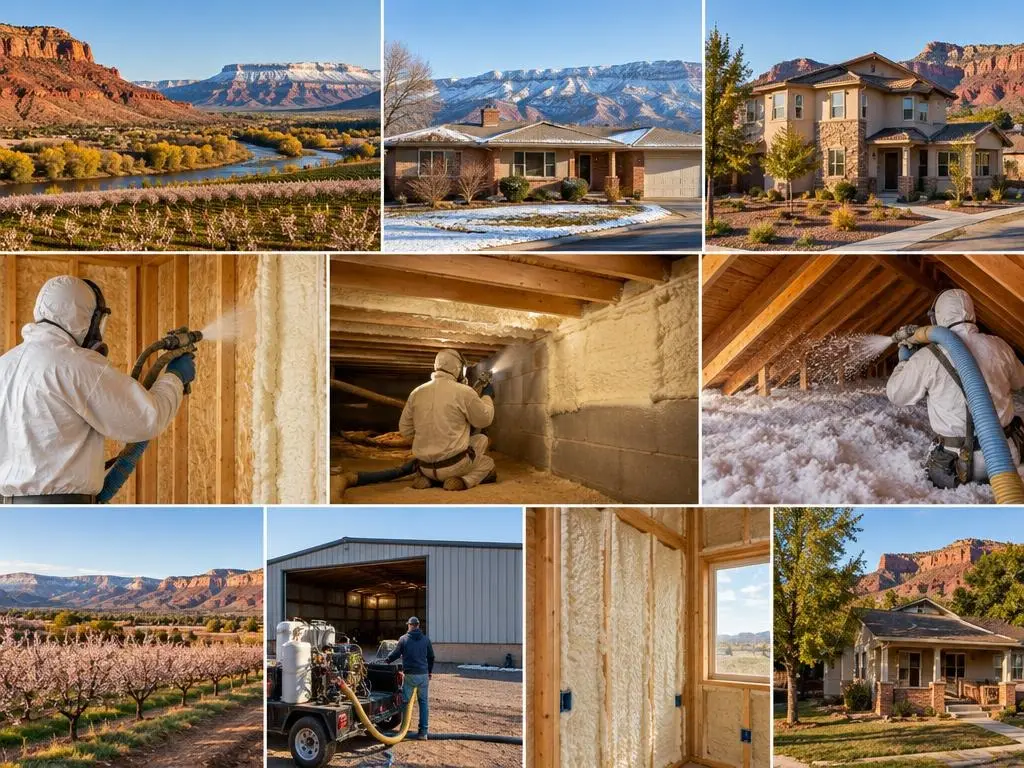
We work throughout Grand Junction and the Grand Valley: Clifton, Fruitvale, Orchard Mesa and the Redlands around the city; Fruita, Loma and Mack to the west; Palisade and De Beque to the east; Whitewater to the south; Glade Park above the Monument; Collbran and Mesa in the Plateau Valley; and Delta down US 50. The valley floor has the most houses on crawl spaces and slabs, the upper valleys and mesas run colder and snowier, and the farm and orchard country has plenty of shops and barns. Each town page covers what is different there.
- Spray Foam Insulation in Grand Junction, CO
- Spray Foam Insulation in Clifton, CO
- Spray Foam Insulation in Fruitvale, CO
- Spray Foam Insulation in Orchard Mesa, CO
- Spray Foam Insulation in Redlands, CO
- Spray Foam Insulation in Fruita, CO
- Spray Foam Insulation in Palisade, CO
- Spray Foam Insulation in Loma, CO
- Spray Foam Insulation in Mack, CO
- Spray Foam Insulation in Whitewater, CO
- Spray Foam Insulation in Glade Park, CO
- Spray Foam Insulation in Collbran, CO
- Spray Foam Insulation in De Beque, CO
- Spray Foam Insulation in Mesa, CO
- Spray Foam Insulation in Delta, CO
Our Services
Six services, from rim joists and crawl spaces to attics, walls, shops and cleanup of old insulation.
Spray Foam Insulation
Open-cell and closed-cell foam for rim joists, crawl space walls, cathedral ceilings, open walls and shops.
Learn more →Attic Insulation & Air Sealing
Sealing the leaks at the top of the house and bringing the attic to Zone 5 depth.
Learn more →Crawl Space & Rim Joist Insulation
Closed-cell foam on rim joists and crawl space walls, ground covers and vent sealing to warm up cold floors.
Learn more →Blown-In Insulation
Cellulose or fiberglass blown into attics and closed walls, the economical way to reach Zone 5 depths.
Learn more →Garage, Shop & Pole Barn Insulation
Foam and sealing for garages, metal shops and pole barns so they hold heat in winter and stay cooler in summer.
Learn more →Insulation Removal & Replacement
Clearing out packed-down, dusty or rodent-damaged insulation, sealing the attic or crawl space, and installing new.
Learn more →
Common Questions
How much should I expect to pay for spray foam insulation?
HomeGuide's national installed range is $1.50 to $5.00 per square foot, with open-cell at $1.50 to $3.50 and closed-cell at $3.00 to $5.00. A spray foam attic runs $3,000 to $8,000 and rim joists $2,000 to $2,500 in that guide. Thickness, access and prep change it, and your written estimate is the price.
Why is spray foam insulation now a red flag?
Usually because of bad installs, or because foam on a roof deck hides the underside of the roof from inspectors and lenders. Foam mixed wrong, sprayed too thick in one pass or put over a leak can cause odor or hidden damage. Careful installation in proper lifts and a written record of what went where address most of the concern.
What should I ask insulation companies in Grand Junction?
Ask what material goes where, how thick, and what R-value it reaches compared with Zone 5 targets. Ask how they handle air sealing and rim joists, what barrier the foam needs, and how long you must stay out while it cures. Compare quotes that spell those out.
Why are people removing spray foam insulation?
Most removals are because foam was put over a roof leak, was mixed wrong and still smells, or is in the way of repairs. Some buyers also want it gone from roof decks. HomeGuide lists foam removal at $1.00 to $2.50 per square foot.
What attic R-value do I need in Grand Junction?
The 2021 IECC, enforced by Mesa County since September 1, 2025, lists R-60 for ceilings in Zone 5. ENERGY STAR recommends R-60 for an uninsulated Zone 5 attic and R-49 added over three to four inches already in place.
Should I use closed cell or open cell in Grand Junction?
Closed-cell is the usual choice for rim joists, crawl space walls and metal buildings because it doubles as a vapor retarder. Open-cell can work in walls and some roof decks if vapor control is handled. Your quote names the foam for each area.
How long do we need to be out of the house?
HomeGuide advises at least 24 hours while spray foam cures. We ventilate during and after the work and give you a return time.
Get a Spray Foam Insulation Estimate in Grand Junction
We check the attic, the crawl space and the rim joists, then send a written price for each area.